There's no one right monthly number. What you spend on financial advisor marketing is ads, production, and management fees, plus the hours your team spends following up. Until you add those together and count the clients you actually win, you can't tell whether the budget is too high, too low, or pointed at the wrong work.
A smaller bill can still be expensive if nobody answers the leads. A larger bill can still be reasonable if it brings in clients at a cost your firm can support. This page is about how to add the cost up, run the math with your own numbers, and decide what to buy next.
Key takeaways
- Count four line items: channel spend, production, management, and follow-up time. Quoting only ad spend hides the real bill.
- A name in your inbox is not a client. Track contacts, conversations, attended meetings, and new clients separately.
- Public 'typical budget' ranges are not a quote for your firm. Get current prices in writing.
- SEO, paid ads, content, and an agency buy different work on different clocks. Compare what you receive, not a headline fee.
- Don't send paid traffic to a generic homepage, skip compliance review, or run campaigns you can't trace back to a new client.
- Doing it yourself vs hiring is about time, skill, and who owns follow-up. Buying more contacts does not add hours to the day.
What you're actually paying for
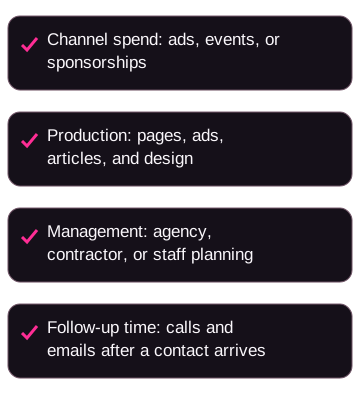
Marketing cost is several bills stacked together. If you only count the ad platform charge, the rest still shows up somewhere.
Channel spend. This is the money that goes to Google, Meta, LinkedIn, sponsorships, or events. It is the most visible number and the one most quotes lead with.
Production. Landing pages, articles, ads, video, and design. If those pieces are weak, you can spend the channel budget and still get little back.
Management. An agency retainer, a contractor, or staff time to plan, launch, and report. Someone has to do that work even if you never hire an agency.
Follow-up time. Calls, emails, and the work of getting a meeting on the calendar. This is easy to leave out because it does not look like a marketing invoice. It still costs you.
Here is a made-up example. A $2,000 Google Ads budget with no dedicated landing page and no one assigned to call people is not a full program. That $2,000 is an illustration, not a recommended budget. You paid for clicks. You did not pay for a process that can turn those clicks into conversations.
When a vendor quotes a monthly fee, ask which of those four buckets it includes. Then write down what you still have to cover in-house.
If you want a starting worksheet, list last month's actual spend in these rows: search ads, social ads, SEO or writing, email and tools, design, events, outside review, and management. Leave a row blank if you did not buy that item. Total the rows, add follow-up hours, then run the meeting and client math in the next sections. Do not copy someone else's monthly totals into those rows.
How to turn a marketing bill into a cost per client
Start with the path a person actually walks.
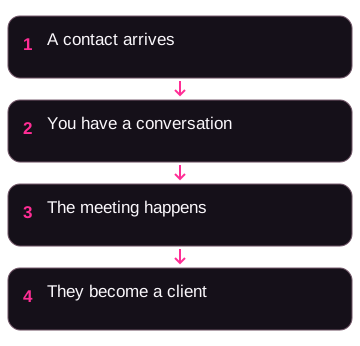
A contact arrives. You have a conversation. A meeting happens. They become a client.
Those are four different counts. If you mix them, a cheap contact can look like a bargain while your calendar stays empty.
Add up one period of cost: vendor invoices plus the staff time spent on that work. Then divide by the number of attended meetings in the same period. Then divide by the number of new clients. Use the same definitions every month or you will compare two different things.
Leave room for lag. Someone who filled out a form in March might sign in June. If you judge a campaign after a week of unanswered calls, you are judging the follow-up, not the whole spend.
Do not turn assets under management into revenue in your head. Revenue is the fee you charge, after you have a signed client. Profit is what's left after you serve them. A cost-per-client number that ignores those steps will flatter the campaign.
Here's the math with made-up numbers
Here is a made-up example. These figures are invented. They are not typical results, OJay results, or a price from any vendor.
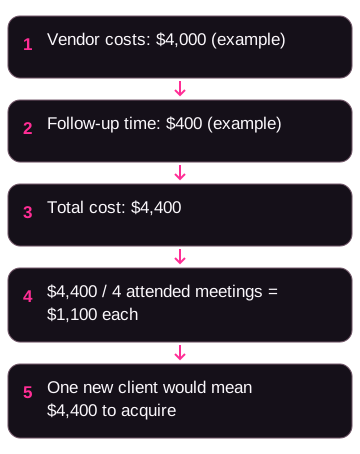
Assume one month of vendor costs is $4,000. Assume follow-up takes 8 hours at $50 an hour, which is $400. Total cost: $4,400.
If 4 meetings actually happened, the cost per attended meeting is $4,400 divided by 4, which is $1,100.
If 1 of those people became a client, the cost to acquire that client is $4,400. If nobody became a client, you spent $4,400 without winning business yet. The cost per meeting cannot tell you whether the month paid off.
Now keep the example going with a made-up client. Suppose that client has $2,000,000 you will bill at 1% a year. First-year advisory revenue in the example is $20,000. That is revenue, not profit. You still have the cost of serving the client, and they might leave sooner than you hope.
$4,400 against $20,000 of first-year revenue is a starting comparison for this example only. It does not mean the spend pays back on a set timetable, and it does not mean a real campaign will look like this. Change any assumption (spend, hours, meetings, fee, or assets) and the result changes.
Use the same worksheet for every channel you test. Include the same types of cost. Count attended meetings the same way. Write the assumptions down so a later review is comparing like with like.
What SEO, ads, content, and an agency actually buy
It makes little sense to compare two prices if one includes a writer, a media buyer, and reporting, and the other is only ad spend. Start with the work itself. Then get a current quote. Older published ranges are not a price for your firm.
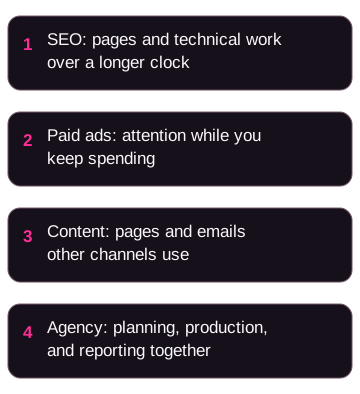
SEO. You are paying for pages, technical fixes, and the time it takes for people to find those pages in search. Useful pages can keep working after you write them. They can also sit unused if they do not match what people ask, or if you stop. Ask any SEO vendor how many pages they will produce, who writes them, who reviews them for your firm, and how they will report on enquiries, not only rankings. SEO does not guarantee leads. For a deeper look at the work, see SEO for financial advisors.
Paid ads. You are paying for attention on a given day, plus whoever manages the account. Clicks and form fills can show up while the ads are running. They also stop when you stop paying, and costs move with competition and the quality of the page you send people to. Ask for a walkthrough of one click: the search or audience, the ad, the page, the form, and who calls the person. See Google Ads for financial advisors and Facebook Ads for financial advisors.
Content. Articles, emails, and pages that the rest of the program uses. Ads need somewhere to land. Search needs something to rank. Follow-up needs something useful to send. Ask what will be written, who the named reviewer is, and how pieces get approved before they go live. See email marketing for financial advisors.
A full-service agency. You are paying someone to plan, produce, and report across more than one of the above. Scopes vary. A shop that has never worked with advisory firms may not know how your review process works. Ask for sample work, who does the work, what is in the monthly fee, and what you still have to staff. We cover how to vet firms in how to choose a marketing agency for financial advisors. OJay Media is a marketing agency for wealth advisors, so we have a commercial interest in that conversation.
Here is a simple comparison worksheet. Fill it with each vendor's written answers, not with guesses.
- What work is included, in hours or deliverables, not slogans?
- What do you still pay for separately (ads, tools, design, legal review)?
- Who follows up when a form is submitted, and within what time?
- How will they define a qualified enquiry, a meeting, and a client?
- What happens if a contact is a duplicate or the details are wrong?
- What is the minimum term, cancellation rule, and what data you keep?
If two vendors cannot answer those in writing, you are not ready to compare their prices.
Competitive cities, narrow niches, and extra review rounds can all raise the bill. An existing list, a clear description of who you help, and someone who actually follows up can lower wasted spend. None of that is a formula. Ask for recent costs on the exact locations and audiences you care about. For how this sits in a wider plan, see wealth management marketing strategies.
Retainer, project, or performance pricing
How you pay shapes what you get, and what you fight about later.
A monthly retainer is a fixed fee for a defined scope. It is easier to budget when the work is ongoing, such as content, ads, or SEO. The risk is paying for activity that is not tied to meetings and clients. Put deliverables and the numbers you will review in the agreement.
Project pricing is a one-time fee for a defined piece of work, such as a website. Clear scope, no ongoing loop. The risk is that the asset sits there with nobody updating ads, pages, or follow-up.
Performance or revenue share ties some of the fee to leads, clients, or assets. That can look aligned. It can also create a fight if 'lead' means a name with no meeting, or if you cannot agree which channel produced the client. Get a written definition of a qualified enquiry before you sign. Have your compliance reviewer look at the incentive structure. This is not legal advice.
A hybrid is a base fee plus a bonus tied to something you can both count. That only works if you already agree on the count.
Whatever the model, name the person at your firm who owns follow-up. A pricing structure cannot replace that.
When to do it yourself and when to hire
This is usually the first budget question, and it is not really a percentage-of-AUM question. It is time, skill, and whether the work will happen every week.
Doing it yourself can make sense when you enjoy the work, you can keep a simple calendar of pages and follow-up, and you are patient enough for slower channels such as search. It is a poor fit when campaigns start and then stall for a month because you were with clients.
Hiring can make sense when your time is already full, you need more channels than you can run well, or you want someone else to keep the work moving. Hiring does not remove your job. You still have to approve work, make time for reviews, and take the meetings.
Here is a made-up opportunity-cost example, not a recommended rate or agency fee. If your time is worth $500 an hour to the firm and you spend 10 hours a month on marketing tasks, that is $5,000 of your time. Compare that with a written quote for the same tasks. The question is not only 'can I do this?' It is 'will I keep doing it, and is that the best use of the hour?'
If nobody has time to follow up, fix that first. Buying more contacts will not create more hours. For the infrastructure around either path, see lead generation for financial advisors.
What not to skip
A dedicated landing page for paid traffic. Sending ad clicks to a homepage makes it harder to see what the person wanted and harder to follow up with one clear next step. Each campaign needs a page that matches the promise in the ad. See financial advisor website design that converts.
Compliance review before something goes live. Ads, pages, emails, and testimonials are marketing choices your firm still has to approve. Do not assume a vendor template is cleared for you. Do not treat this article as legal or compliance advice. Ask your compliance reviewer to check the work. There is no promise here that a given page or campaign is allowed.
A way to see what produced each new client. If you cannot tell which channel, page, or campaign a client came from, you cannot tell which bill to cut or keep. UTM tags, a CRM field for source, and an intake question ('How did you hear about us?') are basic. They are not extras you add after the spend is already confusing.
What to get in writing before you sign
Before you sign, write the answers beside each line of the quote.
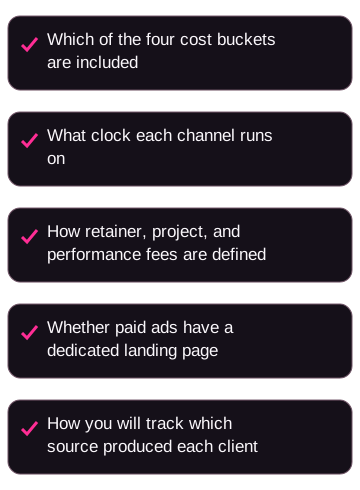
Which of the four cost buckets are included? Channel spend, production, management, and follow-up time. Ask which ones the quote covers and which ones you still pay for in-house.
What clock does each channel run on? Ads can produce enquiries while you are spending. SEO depends on pages people can find, so those enquiries can take longer. Content supports the other channels. An agency fee can cover planning, production, and reporting together. Compare the work and the clock, not a headline monthly number.
How is the fee defined? Retainer, project, and performance (or a hybrid) are different commitments. Get deliverables, the numbers you will review, and a written definition of a qualified enquiry, a meeting, and a client.
Does paid traffic have a dedicated landing page? If you are buying ads, the quote should say where clicks go. A homepage is not a campaign page.
How will you see which source produced each client? UTM tags, a CRM source field, and an intake question are basic. If you cannot trace a client back to a bill, you cannot tell which spend to keep.
Keep the quote and these definitions beside your results so you can compare what was billed with what was delivered.
A few common questions
How much should a financial advisor spend on marketing each month?
There is no universal monthly figure. Add channel spend, production, management, and follow-up time. Compare that total with the meetings and clients you actually get. Set a budget you can sustain long enough to judge the work, and put a review date on the calendar. A number you copied from an old article is not a quote.
Can I just compare the price per lead?
Use it as one part of the comparison. Include membership or management fees, production, and follow-up time. Count attended meetings, then new clients. A cheap contact that never meets with you is not a cheap client.
Is SEO cheaper than paid ads?
They buy different clocks. Ads can produce enquiries while you are spending. SEO depends on pages you already published and on people finding them, so enquiries can take longer to show up than they do while ads are running. Neither one is guaranteed to be cheaper per client. Compare full cost and full results over the same period, with the same definitions.
When should I hire a marketing agency?
When the work is not getting done, when you need skills you do not have, or when your time is better spent with clients. Write down the deliverables you want and get a current proposal. If you are not trying to grow, an agency retainer is probably wasted. If you want people coming to your firm under your name, that is a different product from buying a list of introductions.
What to do next
Pull last month's invoices. Add staff time. Count contacts, attended meetings, and new clients. That is your real cost picture.
Then pick one channel you are considering and ask the vendor to walk you through one person from the first click or form to the information you receive, including the full price and what happens when the details are wrong.
If you want help building pages, ads, and follow-up around your firm, OJay Media does that work. We have a commercial interest in that option. It is marketing help for advisory firms, not investment advice, and it is not a promise of new clients.
Related reading: how to get clients as a wealth manager, how to attract high-net-worth clients, referral marketing for wealth managers, LinkedIn for financial advisors, and cold email for financial advisors.