Getting new clients is a different job from managing the ones you already have. Referrals can carry a wealth manager for a while. They rarely carry you forever.
You get clients when someone who needs your kind of help hears about you, talks with you, shows up, and decides to work with you. The useful work is building more than one way for that to happen, then counting each step honestly.
This article covers referrals, professional introductions, content, LinkedIn, and paid ads. It also covers how to compare costs, how to pick a starting point, and what to send your compliance officer before anything goes live.
Key takeaways
- A name in your inbox is not a client. Track conversations, attended meetings, and signed clients separately.
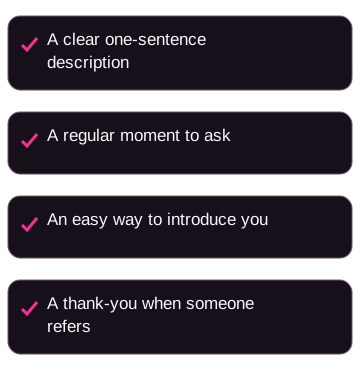
- Referrals still matter. Treat them as a process: a clear description of who you help, a regular ask, an easy introduction, and a thank-you.
- CPAs, attorneys, and similar professionals can introduce you if they know exactly who to send and they get something useful in return.
- Articles, LinkedIn, and ads can all create conversations. None of them works if nobody has time to follow up.
- Compare the cash you spend and the hours you spend, then divide by meetings that actually happened. Use the same definitions every time.
- Have your compliance officer review pages, ads, videos, and social posts before they go live. This is marketing advice, not a legal reading of any rule.
Why referrals stop being enough
Referrals feel right because they are personal. Someone who already trusts you tells a friend. That person often arrives warmer than a stranger who clicked an ad.
The limit is simple. Your clients only know so many people. If referrals are your only source, a quiet quarter can empty the calendar.
That is not an argument for dropping referrals. It is an argument for not betting the whole firm on them.
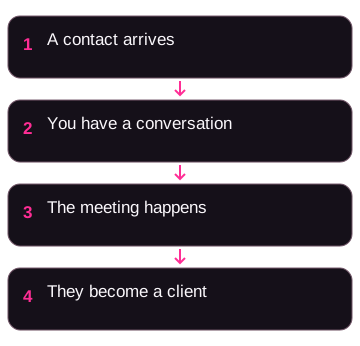
Keep separate counts. A contact must become a conversation, then a meeting that actually happens, then a client. The diagram shows a process, not conversion rates.
- A contact arrives. Someone has asked for help, or someone has introduced you.
- You have a conversation. You find out if there is a fit.
- The meeting happens. Count people who actually attend.
- They become a client. Now you can look at what the work cost you.
A delivered name, a booked appointment, and a meeting that actually happens are three different things. Keep separate counts.
Here is a made-up example. Suppose you get four introductions in a month. You reach two people. One meeting happens. Nobody signs. You did not fail at some mysterious referral skill. You had a follow-up and show-up problem. Getting more names would not have fixed that.
Five ways wealth managers get clients
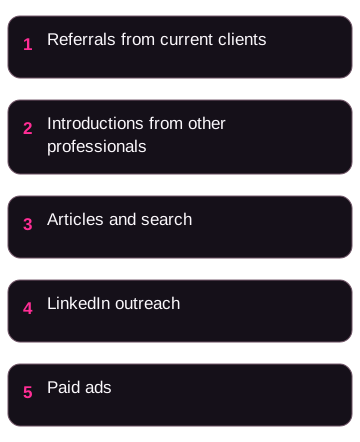
These are the channels most firms actually use. They are not ranked by return. I cannot honestly tell you what each one will produce for your firm.
Referrals from current clients. Low cash cost. Limited by your clients' networks. The person often arrives with some trust already in place. You still need a process, not a hope.
Introductions from other professionals. CPAs, estate attorneys, business attorneys, insurance specialists, and private bankers already sit with people you may want to serve. You spend time, not an ad budget. The introduction is only as good as the relationship and the brief you give them.
Articles and search. You write about the situations your ideal clients are already trying to solve. Over time, some of those pages can be found in search. This is usually slow. You own the pages. Ranking is not guaranteed.
LinkedIn. Useful when you treat it as a place to show how you think, then start conversations. Weak when you mass-connect and pitch. It takes hours. Your compliance team needs to see the messages and posts.
Paid ads. You pay to put a video, article, or offer in front of people. You can spend more to reach more people. You cannot buy a client. You buy a chance at a conversation, then your team has to do the rest.
The diagram compares what each channel asks of you, not what it returns.
Ask the same questions of each one:
- Who, exactly, are you trying to reach?
- What do they already believe they need help with?
- Who follows up, by name, and how fast?
- What are you allowed to say, and who approved it?
- How will you know it is working before a contract renews?
If you want the long version of paid social, search ads, the website those clicks land on, or follow-up after the first touch, start here:
- Facebook ads for financial advisors
- Google Ads for financial advisors
- Financial advisor website design
- SEO for financial advisors
- Email marketing for financial advisors
Turn referrals into a process
Hoping clients remember to mention you is not a system. A referral process is something you can run on purpose.
Give people one sentence they can repeat. "I manage portfolios" does not travel. A sentence like "She helps business owners over 50 think through the tax side of selling the company" is easier to pass along, because the listener can picture a person. Use a description that is actually true for your firm. Do not invent a niche you do not serve.
Create a regular moment to ask. End a quarterly review with a specific question: "Do you know anyone in a similar situation who might want a conversation?" Ask it as a normal part of the meeting, not once a year when the pipeline is empty.
Make the introduction easy. A short email your client can forward. A page for referred people that explains who you help. A scheduling link so they are not stuck in a reply chain. If the path is awkward, many good intentions die there.
Close the loop. Thank the person who referred you, quickly. A note, a call, or a small gift your compliance officer has already approved. People repeat what got a human response.
None of this guarantees more referrals. It just stops you from leaving the whole thing to chance.
Ask other professionals for introductions
A CPA who works with business owners in their fifties and sixties is already in rooms you are not in. When a tax question turns into a planning question, they can say, "You should talk to my colleague."
That only happens if they remember you, trust you, and know who to send.
You are not asking for a favor. You are building something useful in both directions.
Stay in contact. A quarterly lunch or call beats a once-a-year note that only appears when you need names.
Give something back. Refer your clients when a CPA or attorney is the right next step. Share a plain-language explanation they can use in their own conversations. Show up as someone who makes them look good.
Be specific. "Anyone with money" is not usable. "Business owners thinking about selling in the next few years who have not planned for the tax hit" is something a CPA can match to real files. Only use that line if it is true for you.
Then treat those introductions with the same counts as any other channel. An email from a lawyer is still just a contact until you have a conversation, a meeting that happens, and a signed client.
Write for the people you actually want
Content is slow. That is the honest part. A page you publish this month will not fill next week's calendar. The useful part is that you own the page, and a person who finds it can arrive already knowing how you think.
Write for searches that match the work you actually do.
- Someone learning: "How does a Roth conversion work?"
- Someone comparing: "Wealth manager for business owners"
- Someone stuck: "How to reduce taxes in retirement"
Broad topics like "how to invest this year" put you next to giant brands. A tighter page, such as tax-aware withdrawals for Oregon owners selling a company, is easier for the right person to recognize. Only write that page if you truly serve those people. Specificity is a filter, not a ranking trick.
Do not promise that publishing on a schedule will rank, or that a ranked page will become a client. For the search side, see SEO for financial advisors. For staying in touch with people who already know you, see email marketing for financial advisors.
If you need conversations this quarter, treat content as support, not the whole plan.
Use LinkedIn without turning it into a pitch machine
Most wealth managers either ignore LinkedIn or use it like a crowded room: connect with everyone, send a pitch, post a market comment, then wonder why the inbox is quiet.
A more useful way to use it:
Treat your profile as a page, not a resume. Say who you help, what conversations you are for, and what someone should do next. A job title is not a reason to talk.
Show judgment. Write about decisions your ideal clients actually face, in your own words. "Here is how I think about selling a business, and what owners often miss on the tax side" is a point of view. A recycled headline is not.
Connect, then wait. Search for the people you want to serve. Send a note that is about them, not your process. Let your posts do some of the warming. Ask for a conversation later, when there is a reason.
This takes time. One person doing it consistently can create some conversations. I will not pretend I know how many you will get. It also needs compliance sign-off on the profile, the posts, and the messages.
If you buy attention, count the cost of a meeting
Paid ads are the channel people try once, spend a little, get nobody on the calendar, and then decide ads do not work for wealth management.
Sometimes the ads were generic. Sometimes there was no page or video that helped the right person recognize themselves. Sometimes a form captured names and nobody called. Sometimes the site could not book a meeting. For campaign structure, see Facebook ads for financial advisors and Google Ads for financial advisors. For the page those ads hit, see financial advisor website design.
A cleaner way to think about paid attention:
- Someone sees an ad.
- They watch a video or read a page about a situation they recognize.
- They answer a few questions so you can see if a call is worth both sides' time.
- They book.
- They show up.
- They become a client, or they do not.
You pay for the early steps. You earn the later ones.
Some firms use a longer video or a detailed page so the person can see how you think before they book. Someone who stays with a 10-minute video about tax-aware planning for business owners has given you more signal than someone who clicked a headline. That still is not a client. Ten minutes is an example of a longer piece, not a required format.
Do not compare two ad programs on cost per name. A cheap name that never picks up is expensive.
So count the money you spend on ads and fees, and the time your team spends following up. Then divide that total by the meetings that actually happened.
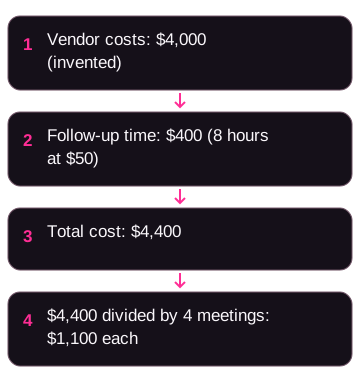
Here's the math with made-up numbers.
Suppose you spend $4,000 on ads and vendor fees in a month. Your team spends eight hours following up at $50 an hour. That is $400 of time. Total cost is $4,400. If four meetings actually happen, that is $1,100 per attended meeting.
$4,000 + $400 = $4,400. $4,400 divided by 4 = $1,100.
These are invented figures, not a benchmark, and not a result from OJay or any ad platform. Your numbers will differ.
Then keep going. How many of those meetings became clients? In this example, one new client would mean $4,400 in acquisition costs. No new clients would mean you spent $4,400 without new fee revenue yet. Cost per meeting alone cannot tell you whether the spend paid off.
Now the AUM trap. Suppose that new household has $900,000 you will manage, and your fee is 1% of assets per year. First-year fee revenue would be $9,000. That is not profit. Serving them still costs time and overhead. $900,000 is not cash in the bank, and $9,000 of fees is not $9,000 of margin. Do not call that a double, or a 2x return. You have not subtracted the cost of the work.
Use the same definitions every month: the same costs, the same meaning of "qualified," the same meaning of "showed up." Otherwise you are comparing two different things.
What usually breaks paid campaigns, in ordinary terms:
- A message anyone could run: "We help people plan for retirement."
- A form with no questions, so you talk to people you cannot help.
- No plan for the people who watch or click and do not book.
- A website that explains the firm and never offers a next step.
You control the spend. You do not control whether those people choose you.
How to pick a starting point
You do not need every channel at once. You need one or two you can actually run, plus follow-up.
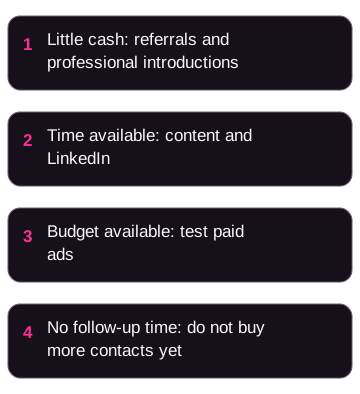
If cash is tight: Start with a referral process and two or three professional relationships. Have the conversations this month. Write down who you help in one sentence so those partners can use it.
If you have time and little budget: Write for a specific client situation, and use LinkedIn as described above. Give it enough calendar time that you are not judging a new page after two quiet weeks.
If you have budget and a follow-up owner: Test paid ads against a page or video built for the people you want, with questions before the calendar. Agree on a spend cap and a review date before you launch. Check the contract's minimum term.
If nobody has hours to call people back: Do not buy more contacts. Fix the follow-up first. Buying names does not add hours to the day.
These are starting points for your decision, not a forecast of clients.
Write this down for whatever you try:
- Cash you will spend in the next 90 days.
- Hours per week, and whose hours they are.
- The person who follows up, by name.
- What counts as a qualified conversation.
- The date you will review the numbers, including meetings that happened, not only leads.
If those answers are vague, the channel is not ready.
Firm size is a rough clue about budget, not a rule. A smaller firm with a clear niche and a person who follows up can run ads. A larger firm with no owner for the inbox can waste a larger budget.
If you are comparing outside help, the buyer's guide to financial advisor marketing agencies is the companion page for that decision. OJay Media is in that market, so we have a commercial interest. The evaluation questions still apply to us.
Get compliance involved before you publish
Wealth-manager marketing is regulated. I am not going to tell you what the SEC Marketing Rule or FINRA advertising rules allow. That depends on your registration, your firm, and the exact piece.
What you can do, practically:
- Send the ad, the landing page, the video script, the LinkedIn post, and the outbound message to your compliance officer before they go live.
- Ask, specifically, how to handle testimonials, endorsements, performance numbers, and "what if you had invested" style examples. Do not use them until you have an answer in writing.
- Ask what you must keep on file. Do not assume a deleted post or a boosted ad has no record.
- Do not treat a blog article, including this one, as permission to publish.
If someone promises "SEC compliant ads," that is a sales line. Compliance is your firm's call on each piece.
What if you want people coming directly to your firm?
Buying introductions and running ads are both ways to start conversations. Another option is to build a path under your own name: a person finds you, reads why you might be the right fit, answers a few questions, and books a call.
That is the work we do at OJay Media. We build the website pages, ads, qualification questions, and follow-up around your firm.
Building that still takes time, money, testing, and follow-up. It is not a substitute for a person who will pick up the phone. You can compare that investment with buying names, or use both. What matters is knowing what you own, what you are paying for, and whether it brings in clients at a cost your business can support.
OJay Media offers this kind of marketing service, so we have a commercial interest in this alternative. It is not the same product as buying leads, and it does not guarantee clients.
If you want to see how we would build this around your firm, schedule a Growth Advisory Call or apply to work with OJay. See how the process works, then decide whether a conversation makes sense.
OJay Media is a marketing agency for wealth advisors. This article is educational. It is not investment, legal, or tax advice, and it is not a promise of clients, revenue, or AUM. You remain responsible for your own marketing review.
A few common questions
Does any channel guarantee new clients?
No. Referrals, partners, content, LinkedIn, and ads can create a chance to talk. The person still has to choose you. Anyone who guarantees clients, revenue, or asset growth is selling certainty they cannot honestly deliver.
Can I just compare cost per lead?
Use it as one number, not the decision. Include setup fees, monthly fees, creative costs, and the hours your team spends. Divide by meetings that happened. Then track how many people became clients, and remember that fee revenue is not profit.
How long should I try a new channel?
Agree on a budget and a review date before you start. Leave enough time to see what happens after the first conversation. Check the minimum term if you are signing with a vendor. A week of unanswered calls is not a full test, and a long contract is not proof the channel works.
What should I send compliance before I launch ads or a LinkedIn series?
The script or post, the page it sends people to, the questions on the form, the targeting description, and how you will follow up. Ask what you may say about clients and results. Wait for approval. I cannot tell you that a given piece is allowed.
What is the first move if I am stuck on referrals?
Write the one sentence that describes who you help. Ask two current clients the referral question this week. Book time with one CPA or attorney who already serves the same people. Name who owns follow-up. Then decide whether you also have budget for a paid test.
More on finding clients as an advisor
- Facebook ads for financial advisors
- Google Ads for financial advisors
- SEO for financial advisors
- Best marketing agency for financial advisors