If you want to reach ultra-high-net-worth people, start by writing down who your firm can actually serve. A wealth label does not tell you which prospects to pursue, who else influences the relationship, or what should happen after someone inquires.
This page is for advisor firms and their marketers. It is about how you find and follow up with the right conversations. It is not investment advice.
Key takeaways
- Start with four filters: the service and complexity you can handle, geography, situations that make a conversation relevant, and the information you need before a meeting. Add finer details once your team agrees on those basics.
- Map the prospect together with the people who can introduce you or control access, then keep only the relationships that are real for your firm.
- Make a relevant situation findable, answer the question it raises, ask for the information you need, and name who follows up.
- Count conversations that match your service, not just inquiries.
- Only use proof you can substantiate, and have your compliance reviewer look at claims, testimonials, and follow-up before you publish.
What this actually means for an advisor firm
You're not writing to investors looking for a product. You're designing how your firm gets into the right conversations.
Don't treat ultra-high-net-worth as one number that everyone agrees on. Net worth, investable assets, and the work your firm can take on are different things. Write your own segment before you buy ads, hire a vendor, or publish a page.
Start with four things you can write down before you pick a channel.
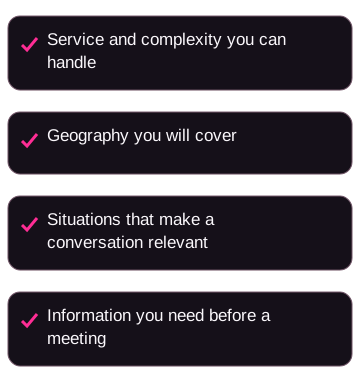
First, the service and complexity you can handle. Second, the geography you will cover. Third, the situations that make a conversation relevant. Fourth, the information you need before you take a meeting.
You may also need liquidity or wealth signals your firm actually uses, how the money was made, who else sits in the relationship, and what you will not take on. Add those once the first four are clear enough that two people on your team would classify the same inquiry the same way.
If the brief is still vague, a marketer and an advisor will sort the same inquiry differently. Fix that before you spend on distribution.
When you turn that positioning into pages people can find, use the related guide on SEO for financial advisors.
Why targeting affluent people is too broad
If a campaign gets attention but almost none of the conversations match the work you do, the problem is often upstream. The message spoke to a wealth identity instead of a situation you can help with.
Check these handoffs:
Who you're talking to. Does the message name a situation and a fit, or only an affluent label?
How you reach them. Are you accounting for the prospect and the people who influence access?
What you published. Does the content answer a high-stakes question in an area your firm is actually allowed to talk about?
What you ask for. Does the form collect enough to decide whether a meeting is worth taking?
Who follows up. After an inquiry, referral, or application arrives, is it obvious who owns the next step?
More inquiries are not automatically better. Look at that in your CRM. If volume is up and accepted conversations are not, you have a fit problem, not a traffic problem.
For a broader look at channels, see lead generation for financial advisors. Keep this page for who you are trying to reach and what happens after they raise their hand.
Map the people around the prospect
Don't pick outreach first. Write down who is in the picture.
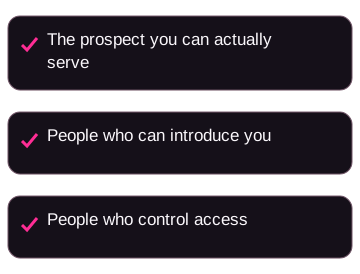
Start with the prospect
Record the signals your firm will actually use: complexity, liquidity, geography, source of wealth, where they are in a decision, and whether other professionals need to be involved. Keep the list short enough that a marketer and an advisor would sort the same inquiry the same way.
Add the people who can introduce you
Existing clients, estate attorneys, CPAs, family-office contacts, executives, business owners, and assistants can all matter. They do not all matter for every firm. Keep the relationships you can substantiate.
When someone else is part of the route, write down:
- why the relationship is relevant
- what you may share, and with whose permission
- who owns the next step
- what the prospect actually asked for
- how you will record the interaction
Name who controls access
Someone may control the calendar, the information, or the internal routing. That is a way to spot where work stalls. It is not a claim about any one person's job.
Ask where details get lost, delayed, or misfiled. Put an owner and a next action on each of those spots.
From first attention to a real conversation
You need a path you own. Each stage has a different job.
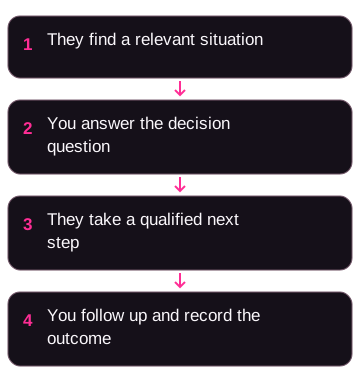
Make the right situation findable
Choose topics, relationships, and distribution that match the people you described. For search, the SEO guide linked above is the implementation reference. For introductions, document the relationship and the permission you need before you contact anyone or share information.
Ask which audience signal or relationship produced this attention, and what makes it relevant.
Answer the question they're actually deciding
Build content around questions that segment asks. A page, a briefing, an event, an email sequence, or a conversation guide can all work. Pick the format after you know the question, who has to approve the copy, and what you want the person to do next.
Useful content does not guarantee they will choose your firm. It makes it easier to see whether a conversation is worth having.
Ask for a qualified next step
Design the form around what you need to decide whether to talk. Ask only for information you will use. Say what happens next. Name who reviews the submission.
Define a qualified opportunity with fields you can observe: service-fit signals, the next step they requested, permission to contact them, jurisdiction, and review status. That definition belongs in your process. It is not an industry standard.
Protect the follow-up
Assign who reviews the form, who contacts the person, how quickly you are aiming to respond, and how the outcome gets recorded. Those controls help you inspect the process. They do not guarantee a client.
If nobody has time to follow up, fix that first. More names will not give your team more hours in the day.
If email is part of follow-up, see email marketing for financial advisors. Segmenting by a wealth signal, a life event, or a funnel stage is a choice to test, and it needs approval for your data and compliance process.
How to use proof without turning it into a promise
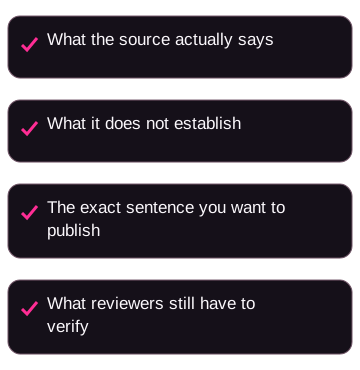
When you review a proof point, separate four things.
What the source actually says, including the timeframe and who it is about.
What it does not establish, including typical results, cause, or that the person was ultra-high-net-worth.
The exact sentence you want to publish, and who will see it.
What your reviewers still have to check: evidence, permissions, disclosures, and approval.
Do not stretch a partner story, a pipeline number, or a closed client into a promise about AUM, income, appointments, rankings, leads, or investment outcomes. If you cannot show the evidence, do not use the line.
What to measure besides inquiry volume
Volume is easy to celebrate and easy to misread. Start with categories you can define, then write the field definitions before you collect the numbers.
A practical sheet can include:
Fit rate. The share of inquiries that match the service-fit criteria you wrote down.
False fits. The share you first marked as a fit that later failed those criteria.
Next-step rate. The share who take the action you asked for, using your own funnel definition.
Accepted conversations. The share of submitted opportunities your team accepts for a real next conversation.
Cost per qualified conversation. Spend divided by the number of opportunities that met your definition, when you can actually attribute the spend.
Source in the CRM. Where each opportunity came from, with enough quality that you can trust the field.
Close rate from accepted opportunities. The share that reach whatever your firm counts as a close.
These are starting points, not universal benchmarks. Agree on the definitions with marketing, the advisor who owns sales, whoever owns the data, and your compliance reviewer before you use them to make budget decisions.
Here is a made-up example.
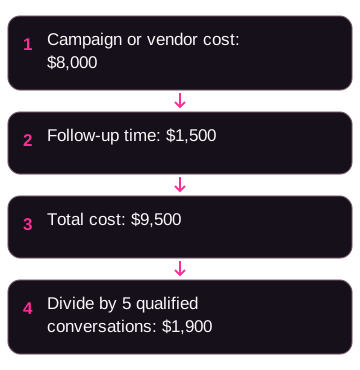
Suppose a month of content, events, or outreach costs $8,000, and your team spends 20 hours following up at $75 an hour. That follow-up time is $1,500. Total cost is $8,000 + $1,500 = $9,500. If 5 inquiries meet your service-fit bar, the example cost is $9,500 / 5 = $1,900 per qualified conversation. If none meet the bar, you spent $9,500 without a usable next step.
Those figures are invented. They are not a result from OJay or from any named campaign. Use your own costs, hours, and counts.
Then keep going. How many of those conversations became clients? What did each client cost to bring in? How long will their fees take to cover that cost after the expense of serving them? Don't convert assets under management into revenue, or revenue into profit, unless you have the actual numbers for that.
Use the same definitions every month. Count accepted conversations the same way, include the same kinds of cost, and allow for the time between a first call and a signed client.
Have your compliance reviewer look at the package
This is a review checklist, not legal advice. Your registration, audience, claims, and internal procedures decide what applies.
Before you run the work, send the exact pages, ads, claims, form, follow-up, and measurement definitions through your firm's reviewer. Confirm:
- how you are classifying the audience
- who has to approve the communication
- substantiation for every performance line, testimonial, endorsement, and outcome
- the disclosures and permissions you need
- how you will keep records
- whether the call to action and follow-up match your procedures
Do not assume a wealth audience makes a claim safer. Do not promise that a page, ad, or process is compliant. Ask your reviewer.
OJay Media is a marketing agency for wealth advisors. This article is not investment advice, legal advice, or a substitute for your firm's compliance process.
A 30-day way to get this on paper
Adjust this to your calendar, your reviewers, and the people you actually have.
Days 1-5: write who you serve
Write the segment brief. Include audience signals, service boundaries, jurisdictions, who sits in the decision, and the minimum information for a reviewable inquiry.
Days 6-10: map how people are reached
Review language from existing clients and the intermediary relationships you are allowed to use. Record questions, objections, referral paths, and handoff points you can substantiate. An interview note is not permission to publish a testimonial.
Days 11-17: make one useful asset
Pick one question that segment actually asks and create one approved asset that answers it. It can support search, an introduction, an event, or follow-up. Keep the next step obvious.
Days 18-23: build the inquiry path
Create the form fields, the confirmation message, the owner, the review state, and the CRM source fields. Test whether the team classifies the same submission the same way.
Days 24-27: set follow-up
Set routing, who contacts the person, the sequence, and how you record the outcome. Use the email guide linked above if email is part of the plan.
Days 28-30: review copy and how you'll count
Submit the exact copy, proof, call to action, form, follow-up, and measurement definitions for required review. Confirm that source fields are usable before you interpret results.
A few common questions
Should you market to every affluent prospect?
Not based on this article. Define who you can serve first. Then test whether the audience and access routes produce conversations that meet your criteria.
Which channel reaches ultra-high-net-worth prospects?
There isn't one channel that always works. Choose among search content, professional relationships, events, email, or other approved routes based on who you're trying to reach, the permission you have, the work you can take on, and whether someone has time to follow up.
How should you qualify an inquiry?
Use a classification your firm wrote down: service-fit signals, the next step requested, contact permission, jurisdiction, and review status. Keep that separate from a wealth label you have not confirmed.
Can you use partner results in marketing?
Only if you can verify the exact figures, timeframe, and who they apply to, and only after your compliance reviewer approves the line. A result is not a typical outcome, a promise, or proof that the person was ultra-high-net-worth.
Does this article give investment advice?
No. OJay Media is a marketing agency. This page covers marketing operations. It does not provide investment, legal, or compliance advice.
If you want people finding your firm, learning why a conversation might be relevant, and applying before they reach your calendar, that's the work we do at OJay Media. We build the pages, ads, qualification questions, and follow-up around your firm, under your name. We have a commercial interest in that option. It is not the same as buying a list of wealthy names.
You can schedule a Growth Advisory Call or apply to work with OJay if you want to see whether that path fits your firm.